01 · AI Systems · The Globe and Mail
News Assistant
Designing the front-end interaction layer for a RAG-based conversational search system: query intent routing, multi-modal result rendering, and trust mechanisms built for a journalism context.
Year
January 2026 – April 2026
Role
Senior Product Designer
Company
The Globe and Mail
Platform
Web and app
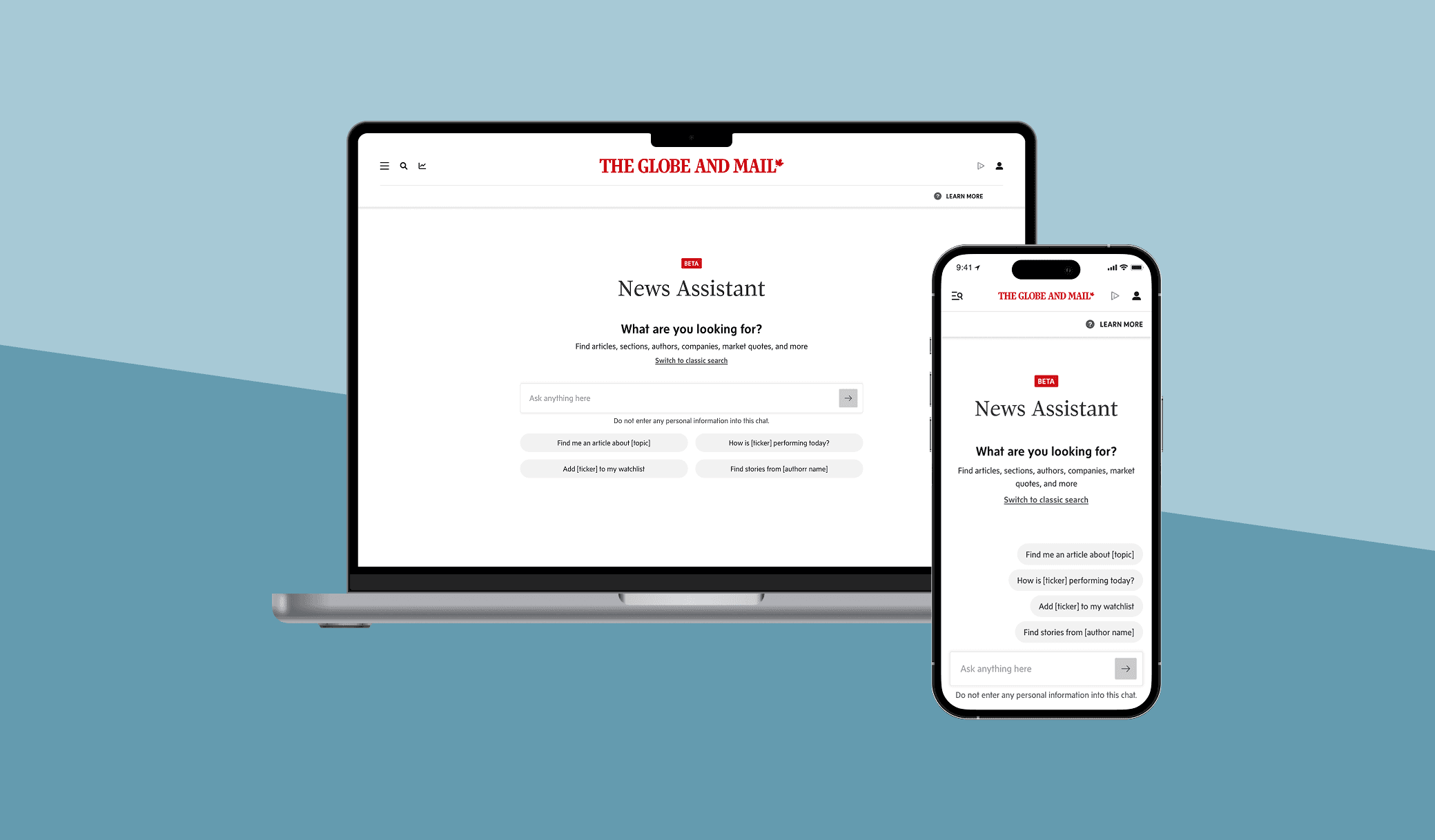
The Problem
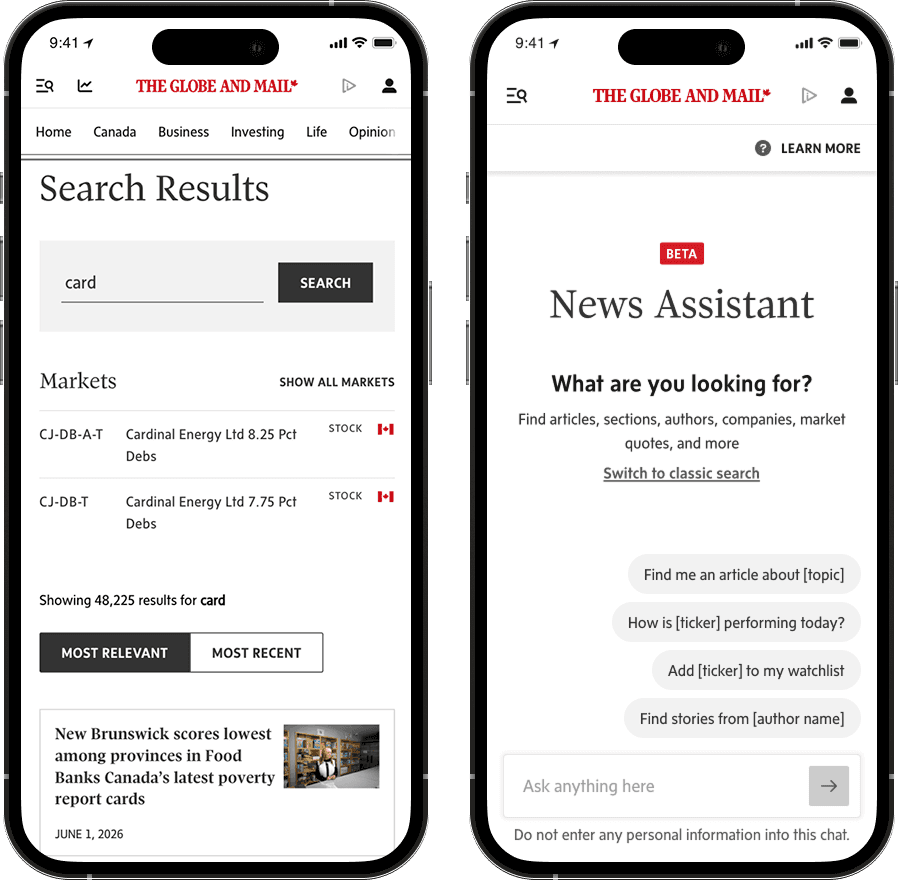
The Globe and Mail’s existing search was a keyword-matching system powered by a third-party vendor, with no semantic understanding, no intent detection, and no path to follow up or refine. Users had to translate their question into the system’s language, not the other way around.
The data science team had built a retrieval-augmented generation model capable of handling natural language queries across editorial content, financial data, and author entities. They needed a front-end experience to surface it, and they had already committed to a vendor delivery date before design was brought in.
What was broken
- Keyword-only matching, no semantic retrieval
- No query intent classification
- No path to refine or follow up
- Web and app on separate vendor systems
- No differentiation between query types
Tags
Core Challenge
How do you design an interaction layer for a model that returns structurally different outputs depending on query intent, while keeping the entry point a single, unified input?
My Role
I owned end-to-end design for News Assistant — from problem framing and research through interaction design, prototype testing, and implementation alignment — working across data science, engineering, product, and research.
The first constraint I pushed back on was getting research in before the vendor deadline locked the scope. Those findings directly shaped four of the five key decisions that followed.
Discovery
With a vendor deadline already set, I designed a three-phase research program (survey, concept evaluation, and diary study) and ran Phase 1 before any interaction design began. The goal was not to validate assumptions, it was to surface the ones worth challenging.
Assumption going in
What we actually learned
Key Insight
Users weren’t asking for AI. They were asking for search that understood their query: faster retrieval, better relevance, clearer results. AI was the mechanism, not the feature.
Entry Point Exploration
Before the research prototype, I explored three directions for the empty state, each testing a different hypothesis about how users would orient themselves in a new search experience.
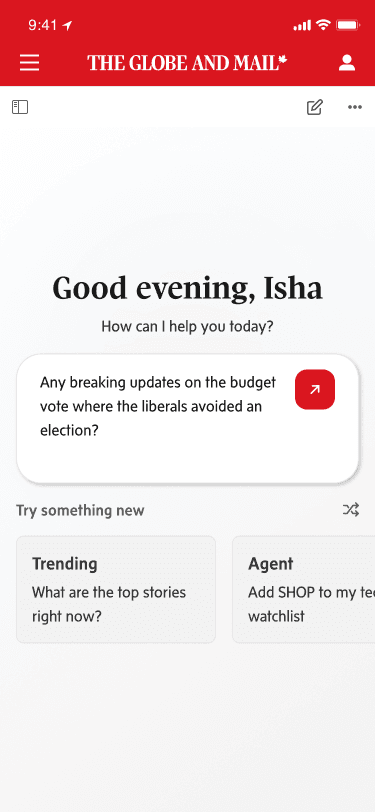
Personalized greeting
Logged-in state with time-of-day context and a pre-populated example query
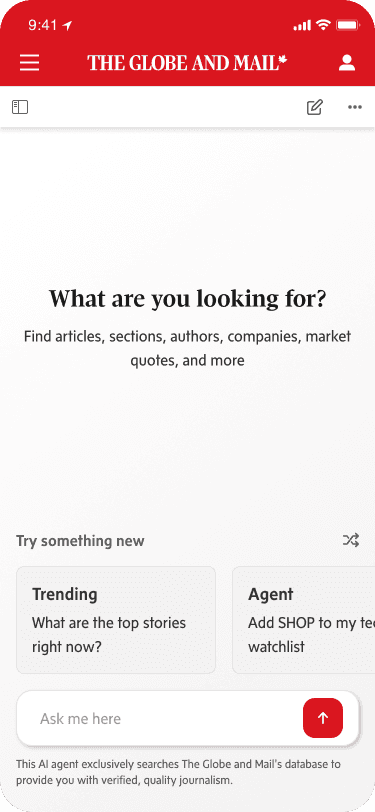
Prompt-first with shuffle
Categorized prompt chips with a shuffle mechanic for users with no specific query
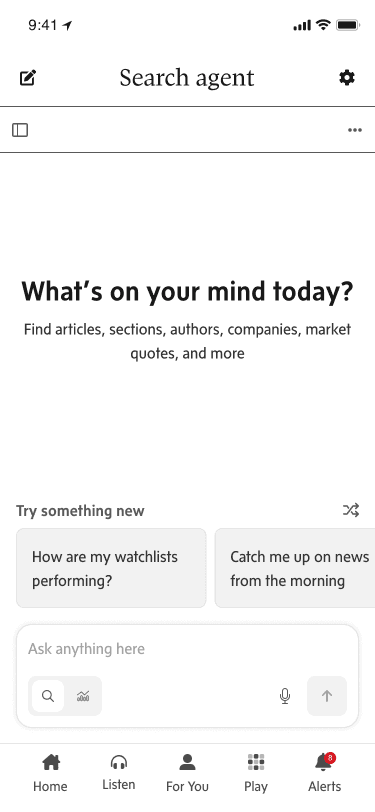
Dual-mode input
Explored two search modes (general news and market/stocks) with a mode toggle in the input bar
Research Prototype
Before locking the MVP scope, I built an interactive prototype and ran concept evaluation sessions with 10 Globe and Mail subscribers. The prototype tested the dual-mode system, the tab architecture, and result grouping. Four patterns shaped every decision that followed.
Input behavior
Conversational UI does not mean conversational input
Participants defaulted to short keyword queries regardless of the interface. Design couldn't override ingrained search behavior.
Result structure
Grouped results reduced scanning time
Intent-matched headings helped users assess coverage faster than a flat ranked list. Grouping was doing the interpretive work.
Trust mechanics
Escape hatches increase willingness to engage
Knowing they could revert to classic search reduced perceived risk — without users ever needing to use it.
Financial queries
Structured data outperformed text for financial output
Users preferred live price, chart, and key metrics as a component over AI-generated text. Structured equals credible. Conversational equals uncertain.
Interaction Flows
I mapped the full interaction model across three query types (general news, financial, and author), each with branching paths based on what the model returns.
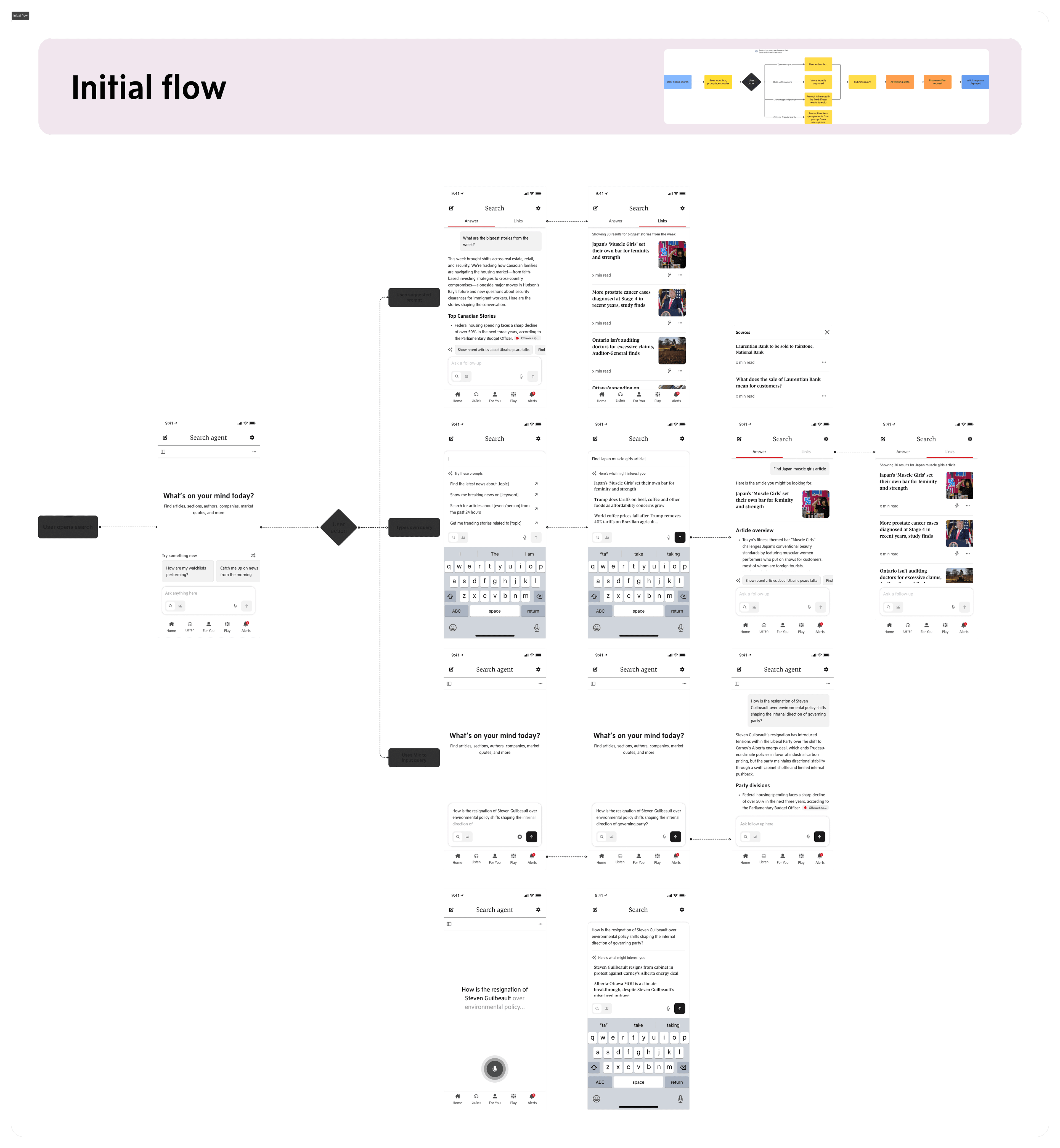
General news flow
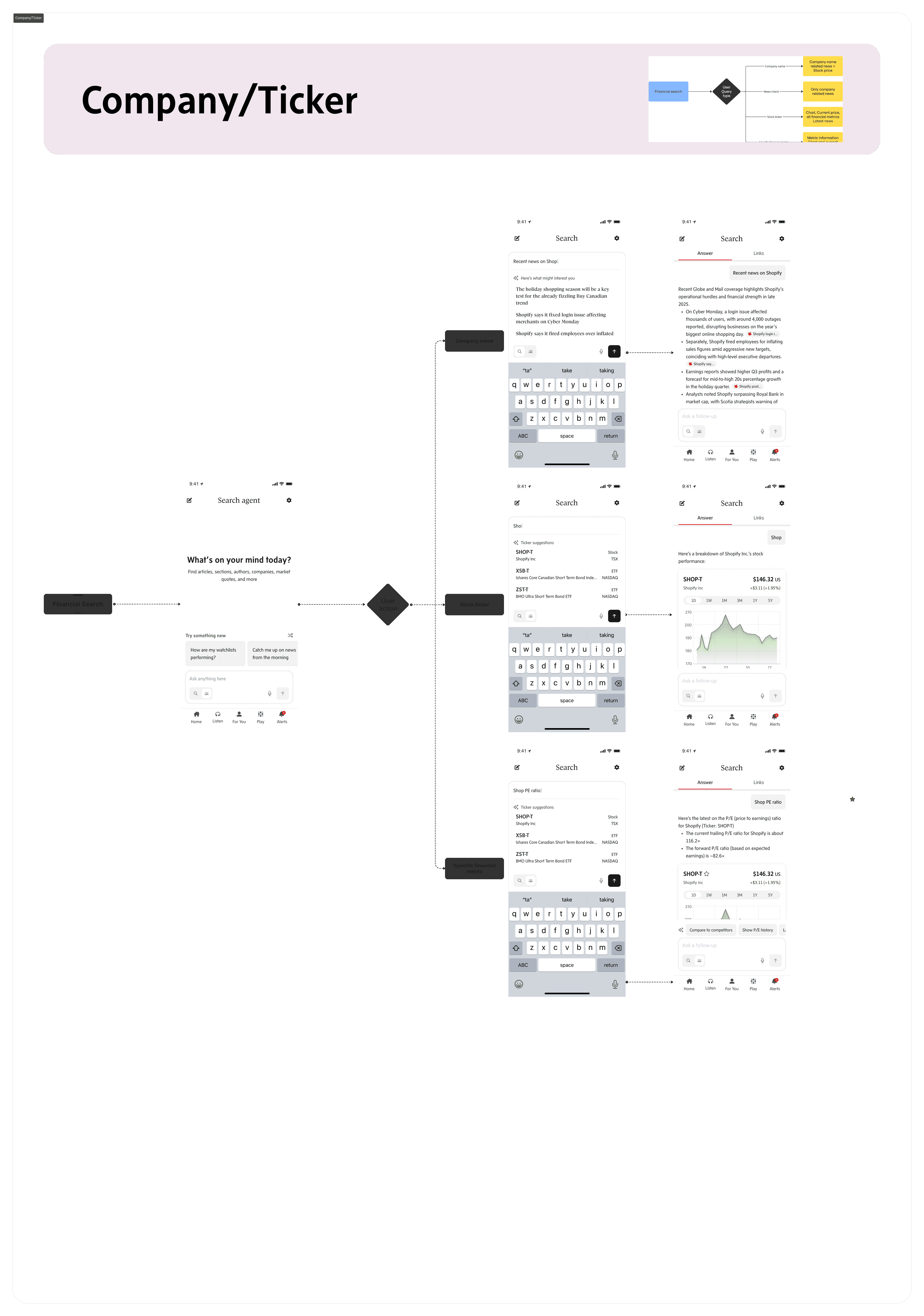
Financial / ticker flow
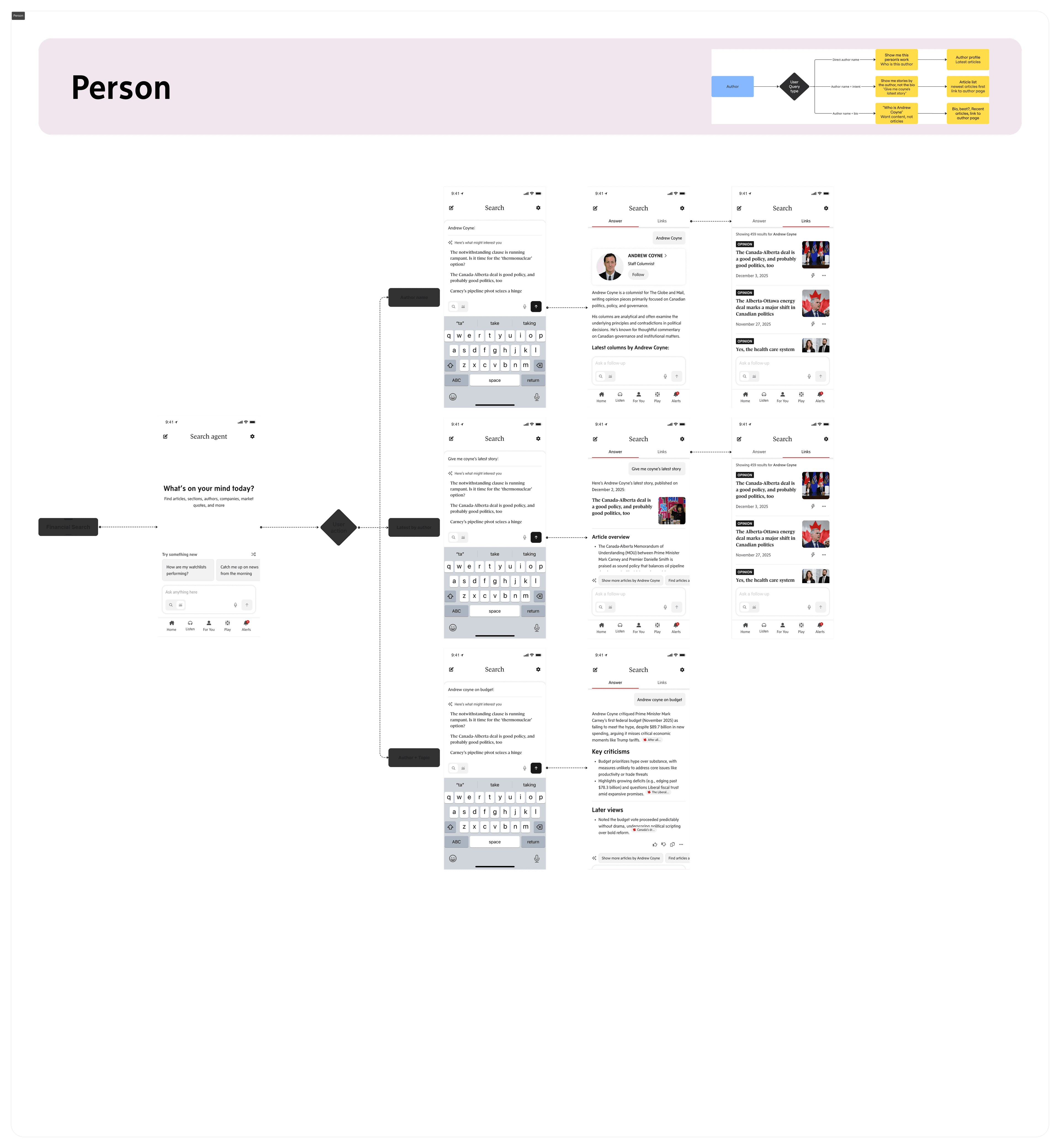
Author / person flow
Key Decisions
One model, not two
Collapse two separate search modes (financial and editorial) into a single model with internal intent routing, removing the need for upfront mode selection.
Why it mattered
A Shopify query is simultaneously financial and editorial. Asking users to pre-classify their intent before typing adds friction and assumes categorical clarity they rarely have.
Tradeoff
A unified model is harder to optimize at the edges. But a single, intent-aware input surface is always faster and less error-prone than asking users to make a decision before they have started.
Architect the tab system for phased delivery
Separate AI-ranked results (Best matches) from raw retrieval results (All articles) in a tab system designed to carry AI summaries in a later phase, without requiring a redesign.
Why it mattered
Summaries carry hallucination risk and require model validation at scale before they can be trusted in a journalism context. MVP needed to ship reliable results immediately. Summaries follow once the model has earned that trust.
Tradeoff
Best matches in MVP would feel less differentiated than the full conversational vision. The value lives in relevance ranking and result grouping, not yet synthesis. The architecture was the long bet.
Route query intent to purpose-built result components
Build four distinct result rendering systems (editorial article cards, financial data components with live price, interactive chart, and key metrics, author entity cards, and comparison carousels) triggered by intent classification from the model.
Why it mattered
A financial ticker query and an author-on-policy query are structurally different information needs. Rendering the same article list for both fails both. The result type has to match the query type.
Tradeoff
Four result types required tight backend contract alignment. Design effectively defined part of the model's output schema.
Embed trust at the surface, not in onboarding
Build trust signals directly into every screen: BETA badge, a classic search escape hatch, financial data disclaimer with source attribution, and an in-context feedback link, rather than centralizing them in a help flow or onboarding modal.
Why it mattered
Research showed control and transparency were non-negotiable, especially for financial queries and for users skeptical of AI. Trust has to appear at the moment of doubt, not behind a separate click.
Tradeoff
More elements competing for visual attention on every screen. Each one is justified by a specific failure mode it prevents. Removing any of them in testing measurably reduced user confidence.
Design the north star. Ship the MVP.
Fully design chat history, follow-up prompt suggestions, and AI summaries as part of the product vision, then deliberately descope all three for MVP while keeping the architecture ready to activate them.
Why it mattered
Shipping all of it would have introduced trust risk before the model had real-world validation, and missed the vendor timeline. Scoping the MVP was not a constraint imposed on us. It was the right product decision.
Tradeoff
The first release would not feel fully conversational. But it would be reliable, shippable, and extensible, which mattered more than impressive.
Final Design
The MVP ships with a single unified input, four result rendering systems, the tab architecture, and trust signals embedded at every surface. Chat history, follow-up prompt suggestions, and AI summaries are designed and ready, and will be activated in phase two as the model builds validation.
Desktop
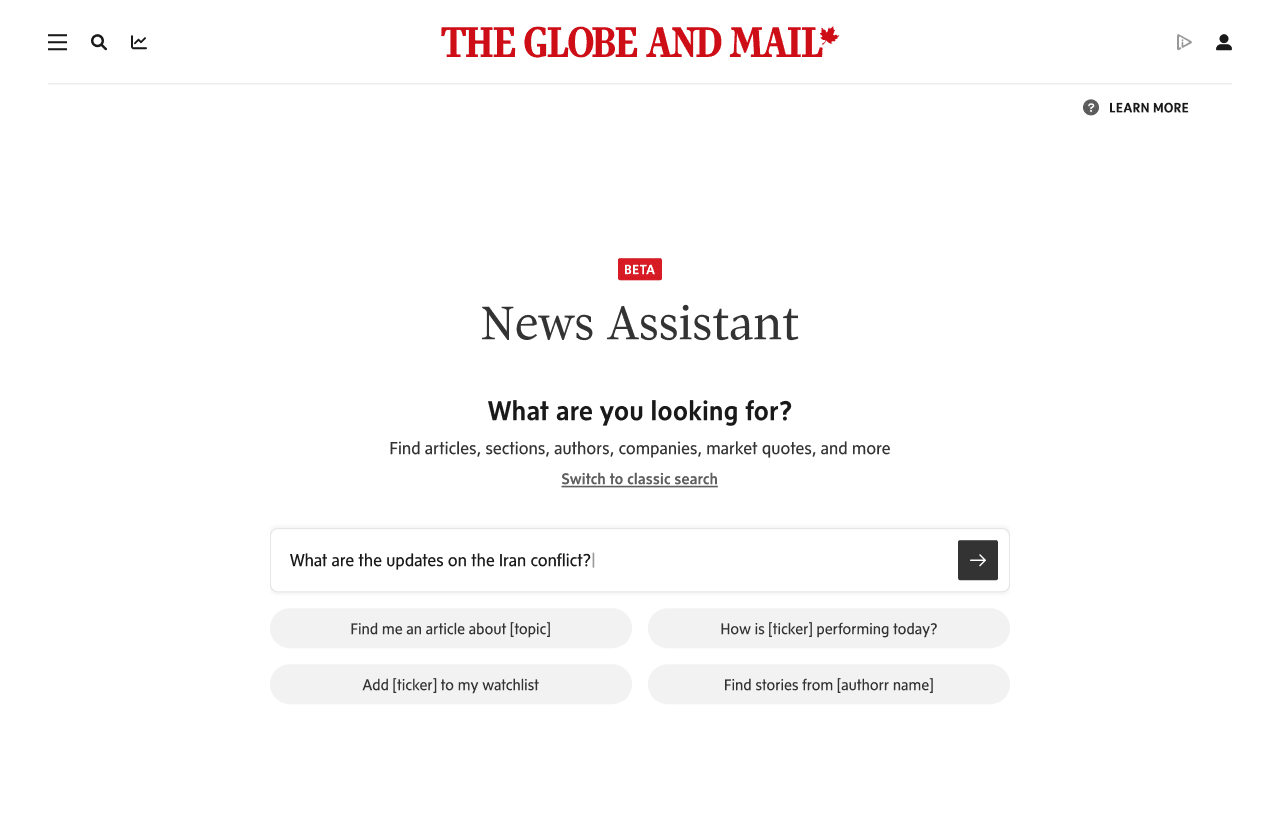
Empty state: BETA badge, prompt chips, and classic search escape hatch
Mobile
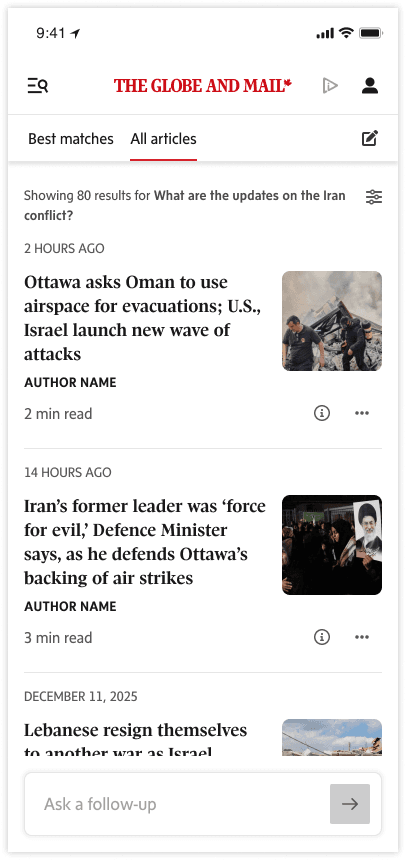
Best matches: chat bubble query, Latest updates grouping
Financial result components
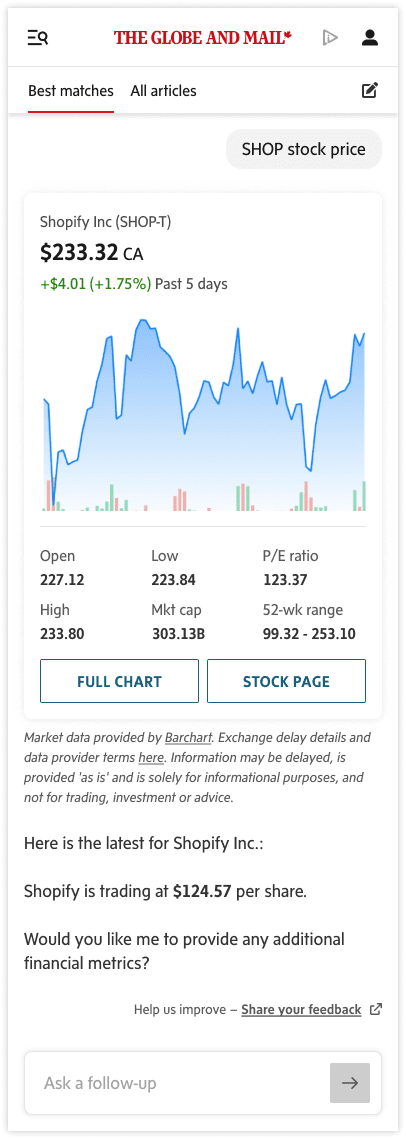
Single stock: live price, chart, key metrics, and financial data disclaimer
Author entity results
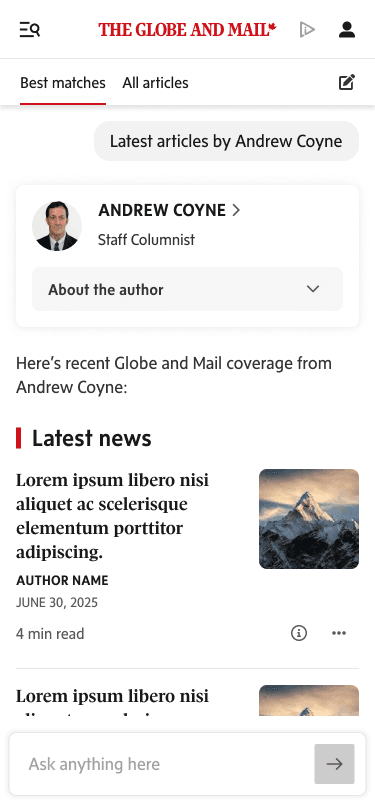
Bio collapsed by default. Primary intent is finding articles, not reading a biography.
Filter panel
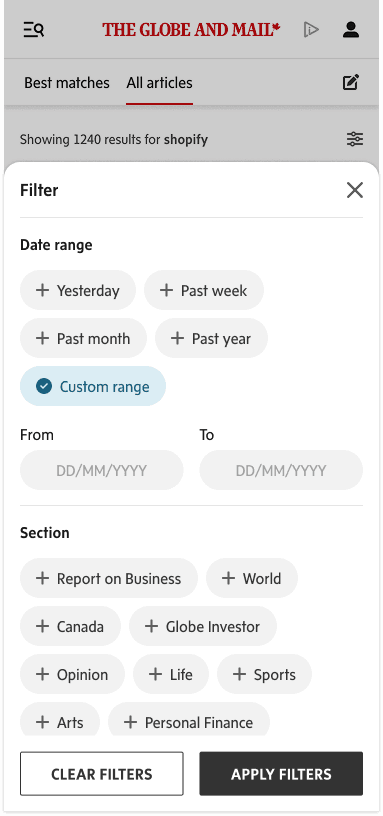
Additive multi-select across date range and section. Applies to All articles only, leaving Best matches unfiltered by design.
Working Across Teams
Defined result type taxonomy the interaction layer needed to support
Aligned with data science on structured output schemas for each rendering path
Pushed for typed financial entity responses to power live data components
Established guardrails for when the model should defer rather than generate
Translated prototype interaction states into engineering requirements
Negotiated MVP scope against the vendor timeline without cutting the core architecture
Outcome
Shipped on time as a subscriber beta, with research, design, and engineering aligned on MVP scope against a hard vendor deadline.
Unified model with intent routing — no upfront mode selection required.
Tab architecture designed to carry AI summaries in phase two without a redesign.
Four result rendering systems defined with data science as part of the model output contract.
Trust signals embedded at the surface reduced dropout and increased willingness to engage with AI results in beta testing.
Reflection
The clearest signal from this project: the most impactful trust mechanism was a single line of text, Switch to classic search. It functions as a confidence builder. Users are more willing to engage with an unfamiliar system when they can see the exit. That pattern applies far beyond AI.
The hardest call was holding back summaries. The whole product vision is conversational synthesis. We designed for it, prototyped it, aligned data science on it. Then we chose not to ship it in MVP because the model hadn’t earned the trust that AI-generated summaries require in a journalism context. Building something and deliberately choosing not to release it yet is counterintuitive. It was the right decision.
What I’d explore next
Query reformulation patterns: where users retype, signalling the model misfired
Best matches vs. All articles tab distribution: where AI results fall short of intent
Conditions under which summaries can be introduced safely as model confidence scales
Chat history and session persistence as the experience evolves from search to agent
Next project
Promotion Path to Purchase
Retail UX · 2022–2024